I have a new genealogical practice.
I Google.
A lot.
And I get really interesting results. It's hard, but I try to focus my searches on one person. Just Googling a name is not very effective though, so I add a date and a place. For instance, "Samuel Mack, 1770 Liverpool, Nova Scotia" was a fairly productive search; as was "Samuel Mack, 1736 East Haddam CT".
I ended up with close to 30+ pages of results. I stopped looking at each result at page 26 though, since the actual information in the links after that started to regress to some pretty bizarre non-family-related information.
Among the "good" results: I connected to a new cousin in Florida and found a hand-written genealogy chart with Ephraim Dean listed on it in Disbray Museum, Bridgewater, NS (waiting to hear if they still have the document); I found some pictures of "Mack homestead" in Port Medway NS and some photographs of Mack gravestones in Mill Village, NS (that I didn't have!!!); and I found some photographs of Macks from the Robert Phalen Collection at the Thomas Raddall Research Centre in Liverpool, NS, but I'm not certain which relatives they are yet.
My two favorite search results have to be these though:
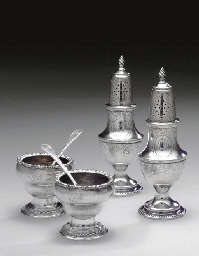
"CHRISTIES
A Rare Pair of Silver Salt Cellars, Spoons, and a Pair of Pepper Casters
The salt cellars and spoons mark of Stephen Emery, Boston, circa 1790
Lot 195/Sale 1617
Price Realized $16,800.
Lot Description
A RARE PAIR OF SILVER SALT CELLARS, SPOONS, AND A PAIR OF PEPPER CASTERS
THE SALT CELLARS AND SPOONS MARK OF STEPHEN EMERY, BOSTON, CIRCA 1 7 90
The salt cellars of double-bellied baluster form, on circular foot with gadrooned border, the bowls with shaped gadrooned rims, marked under bases; the salt spoons with shaped bowls and beaded stems, each marked on reverse; the casters of vase form, on circular beaded foot, the body engraved with paterae and swags, and centering an oval cartouche engraved with a monogram, the detachable cover with piercing within oval cartouches and engraved with paterae and swags, with flame finial, apparently unmarked; the salt cellars, salt spoons and casters engraved with monogram PD. The salt cellars 2-1/2 in. diameter; the spoons 4 in. long; the casters 6-7 /8 in. high; 19 oz. 10 dwt. (6).
Provenance
Patrick Doran (1757 -1818) m . Desiah Cahoon (b. Barnstable, MA 1747, d. 1809 Liverpool, Nova Scotia)
Daughter, Eleanor Doran (1791-1831) m . Samuel John Davison (1791-1825)
Son, Edward Doran Davison I (1819-1894) m. Desiah Mack (1821-1886)
Son, Edward Doran Davison II (1845-1902) m . secondly Margaret A. Robertson (1867-1895)
Son, Harold Doran Davison (1890-1965) m . first Helen Hastings
Daughter, Margaret Helen Davison (b.c.1918) m. Daniel Whiting Lathrop (b.c. 1916)
Son, Harold Doran Lathrop (b. 1944)
Lot Notes
Patrick Doran was born in Waterford, Ireland in 1757 and emigrated to Nova Scotia where he conducted an active business with New England. In 1785 he married the widow Desiah (or Desire) Cahoon Mack. Desiah was the daughter of Massachusetts-born William Cahoon, and the family had settled in Port Medway, near Bridgewater, as one of the original proprietors of Liverpool Township. Desiah's first husband, Connecticut-born Samuel Mack was an operator of two sawmills in Nova Scotia. Upon her first husband's death, Desiah bought 200 acres of land and received the rights to two sawmills from her father. Her second marriage to Patrick Doran in 1785 brought the mills under his control.
Under Patrick Doran, the mill business flourished with lumber shipments to New England and the West Indies. He was a prominent member of the community, serving as a Captain in the militia and long-time Magistrate of Mill Village. The family resided in Mill Village, in the house illustrated below, which still stands.
Upon Patrick's death, his personal possessions were divided between his three surviving children, and his will stipulated that his lands could not be sold for a period of 99 years. In turn, these descended to his grandson, Edward Davison I, who was raised by his spinster aunt, Catherine Doran, after the early death of his parents. At the age of majority Davison inherited 580 acres, a sawmill, fishing rights and the residence at Mill Village. An astute businessman, he increased the family's holdings to 200,000 acres by the 1880s, running five mills, of which three had an output of 250,000 feet daily. The family became known as the "Lumber Kings of Nova Scotia."
With such strong familial and commercial ties to New England, Patrick Doran would easily have acquired the suite of silver salt cellars and pepper casters in Boston. Engraved with his monogram, the suite has been passed carefully to successive generations of the Doran-Davison family to the present owner.
(See: The Canadian Biographical Dictionary and Portrait Gallery of Eminent and Self Made Men, 1881; The Dictionary of Canadian Biography; The Heritage Trust of Nova Scotia, South Shore: Seasoned Timbers, Volume 2: Some Historic Buildings from Nova Scotia's South Shore, 1974; Will Books of Queen's County , Nova Scotia; T. B. Smith Collection of Queen's County Families). Special thanks to Queen's County Museum and the DesBrisay Museum, Bridgewater, Nova Scotia, for their assistance."
There's a lot of genealogy related information packed into this one webpage. Most of it I knew, but I did pick up a few more references to check for further information.
The second is this:

From the website http://antiquesandthearts.com, this rather lovely collection from the annual ADA/Historic Deerfield Antique Show in Deerfield Mass. The write-up of the antique show was crafted by R. Scudder Smith and the description reads:
"For those who turned to the left upon entering the building, Peter H. Eaton Antiques, Inc, and Joan R. Brownstein, Newbury, Mass., were there in the first booth with a collection of furniture and paintings. A country Queen Anne chest on frame from the Mack family of East Haddam, Conn., circa 1785, measuring 57 inches high and 36¼ inches wide, was offered, along with a Queen Anne two-drawer blanket chest, dovetailed, cutout skirt with center drop, in the original Spanish brown paint. This Connecticut River Valley piece, of strong tiger maple, dates circa 1750–1760. A pair of portraits, attributed to Milton W. Hopkins, descended in the family of Frederick Baker whose ancestors were among the early settlers of Pompey Hill, N.Y. Both subjects are seated with a fringed, red swaged drapery in the background."
I am still happily amazed at what can be found on the internet.
But more than that; finding an ancestor's actual possession makes the individual more multi-dimensional, which is incredibly bonding for me, in a way that mere words on a page often don't do.


